Showing posts with label preschool. Show all posts

Tuesday, December 20, 2011

What is the Reggio Emilia Approach?

A child's drawing from Reggio Emilia, Italy
The Reggio Emilia Approach is a philosophy and set of practices for early childhood education that were developed in Italy in the city of Reggio Emilia. The approach has gained popularity in America, and while only a handful of preschools are strictly “Reggio,” a growing number are “Reggio inspired.”

The first Reggio Emilia school was opened after WWII. The community was rebuilding, and in a backlash against Fascist ideology, the town wanted to make sure the new school allowed students to define what they learned, rather than allowing traditional top-down teaching. The resulting school was one in which teachers spend a great deal of time observing children and then presenting information of interest to them.

Saturday, August 27, 2011

Empowering Children to Solve their Own Problems

My last post was about letting children solve their own problems. Even as young as three, I find that children can resolve their own conflicts if you empower them with the right phrases. Preschool children want to get along with their peers, but sometimes they don’t know what to do when problems arise.

For example, when one child bumps into another, the child that was bumped into might start crying and run tell the teacher. The child who did the bumping might not know what an accident is, and he might think that any time he hits someone else, he could get in trouble. He might not know that a simple “I’m sorry,” can solve the problem.

Thursday, August 25, 2011

Adult Intervention

I recently watched the following scene take place among fourth grade boys on the playground. The boys were playing kickball. One boy kicked the ball deep into the outfield. As he rounded second base, the shortstop intentionally stuck his foot out and tripped him. The boy stumbled, but did not fall over. He stopped running and turned to the boy and said in a condescending tone “What are you doing?” The batting team started yelling at their teammate to keep running. The boy ran and tagged home and then turned back to the kid who had tripped him and said “But seriously man, what are you doing? What’s your problem?” He didn’t yell, but he got close to the boy’s face. The boy had nothing to say, and the base-runner finally dropped the subject.

Tuesday, August 23, 2011

Creativity for Life


“We especially need imagination in science. It is not all mathematics, nor all logic, but it is somewhat beauty and poetry.” Maria Montessori

In my last post I mentioned that secondary and post-secondary education often do not deliver the skills most needed in the workplace. Creativity is one of these skills, and its absence in education extends all the way down to preschool.

Saturday, July 23, 2011

The Failure of Secondary and Post-Secondary Education: Just Grab a Dang Parachute

Secondary and post-secondary education is failing us. A growing number of critics have realized that the skills and knowledge young adults of my generation are equipped with in high schools and liberal arts colleges have little correlation to real-life jobs. We find that no one will hire us, and if we get a job, little of what we learned in school prepared us to do that job.

Sunday, July 10, 2011

Everyone's a Winner- The Self-Esteem Parenting Model

The Self-Esteem Parenting Model is one common parenting strategy that has been nearly universal among middle-class families from at least the 1980s to the present. The model assumes that a high self-esteem is essential for a child’s success and that parents should promote and defend their child’s self-esteem as often as possible. Parents frequently tell their children that they are smart and great. They praise every half-hearted crayon scribble their child produces. Competition is avoided. Four-year-old soccer games are not scored, and whatever the game is, there are never any losers.

Sunday, June 26, 2011

The Crappy Toy Dilemma

I cringe when I walk into a child care facility or child’s bedroom and see a field of mismatched, broken, dismantled toys scatted about the room. A Playschool truck missing a wheel. A naked Barbie. A few Monopoly dollars. This scene is caused by what I call the Crappy Toy Dilemma.

The Crappy Toy Dilemma is a catch 22. We buy children toys that are poorly made from low quality material, usually plastic, because we anticipate them being lost or broken. But children loose and break toys because we do do not teach them how to take better care for them because we know their just cheap plastic.

Wednesday, April 27, 2011

The Cons of Montessori

For all its positive features and beneficial outcomes, Montessori has room for improvement is several significant ways:

1. Montessori materials and lessons are outdated. In the “practical life” area, children in Montessori schools today still learn how to polish silver and wash clothes on a washboard. I can’t think of a skill less practical for someone born in 2007 than washing clothes on a washboard.

The Pros of Montessori

Children educated using the Montessori method perform higher academically and are more socially developed than their peers. Montessori students generally outperform their peers at the secondary level, and Montessori students are more motivated and better socially adapted.

The Montessori method must be doing something right. From my early childhood education research and my experience working in Montessori, I believe the positive outcomes of Montessori are derived primarily from these features:

Wednesday, April 20, 2011

What is Montessori anyways?

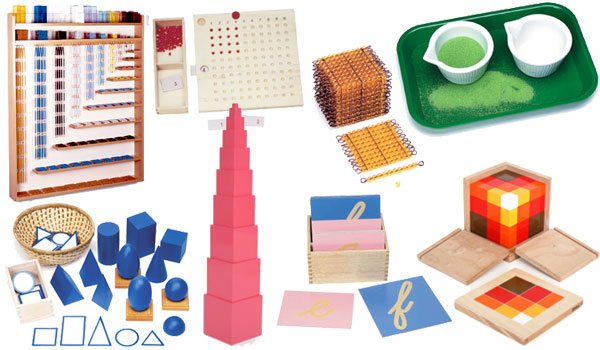
Montessori Materials

When I mention that I have worked at a Montessori school, a common response is “I went to a Montessori school. All I remember is...(I always wanted to make snack, my teacher let a kid wear his shoes on the wrong feet, etc.) What is Montessori anyway?”

Montessori is a method of education developed by the Italian physician and teacher Dr. Maria Montessori. The Montessori method begins with the premise that children have an absorbent mind that learns from the environment more than from teachers. Therefore, the Montessori classroom is one where teachers serve as guides and students learn from a “prepared environment.”

Tuesday, April 19, 2011

Reach Out and Read

Last week the New York times published Rx: Read: Training doctors to promote literacy in their youngest patients. It reports that a non-profit organization called Reach Out and Read is improving language development in children of low-income families.
The program trains doctors to encourage parents to read to their babies. Doctors hand out books at each checkup. They are also trained to use books as a tool to asses children's development. For example, a doctor might assess the motor skills of an infant by how well an she can lift a book or the cognitive skills of a toddler by how closely he looks at the pictures.